

Clothes donation bins in Perth are secure textile collection containers placed across suburbs that allow residents to donate clothing, shoes, and household textiles for reuse or recycling instead of sending them to landfill. By using these local donation bins, Perth households can redirect unwanted garments into structured community support and textile recycling systems rather than general waste streams.
This means unwanted clothing can be reused, repurposed, or responsibly recycled—helping reduce landfill impact while supporting people and communities who benefit from donated goods.
Because this whole donation and recycling process involves multiple stages, this guide explains it clearly, step by step. You’ll learn how clothes donation bins work, what you can donate, how textile recycling reduces landfill impact, and where to find the most convenient donation options near you.
If you want to clear space at home while helping someone in need—without contributing to landfill—this guide outlines exactly how to do it responsibly.
Why Responsible Decluttering Matters
Decluttering with care does more than free up wardrobe space. It reduces waste, lowers greenhouse gas emissions, and helps protect waterways from textile-related microplastic pollution.
This matters locally. Western Australia generates millions of tonnes of waste each year, and textiles form a growing share of that stream. Large volumes of clothing are discarded annually, much of it still reusable or recyclable. The WA Waste Authority’s reporting continues to highlight the need for stronger diversion programs to prevent recoverable materials, including textiles, from ending up in landfill.
Textile waste creates environmental pressure for three key reasons:
- Landfill impact: When textiles enter a landfill, natural fibers can emit greenhouse gases as they decompose, while synthetic fabrics may persist for decades or longer.
- Microfiber pollution: Synthetic clothing sheds microfibers during wear, washing, and breakdown. These fibers enter waterways and marine ecosystems, contributing to long-term environmental contamination.
- Low recycling rates: Only a small proportion of post-consumer textiles are currently recycled in Australia. This means most discarded clothing still goes to landfills rather than being recovered.
For Perth households, this means everyday decluttering decisions have environmental consequences. Choosing to donate, reuse, or recycle textiles helps divert waste from landfills, conserve resources, and reduce emissions.
That is why accessible local solutions like secure clothes donation bins and structured textile recovery programs play an important role in building a more sustainable textile economy across Western Australia.
Next, let’s look at the personal benefits of decluttering, beyond just creating space.
Benefits Of Decluttering: More Than Just Space
Decluttering helps your home, your headspace, and your community.
- More space at home. Free up wardrobes, cupboards, and storage by removing items you no longer use.
- Mental clarity. A tidier environment reduces decision fatigue and stress.
- Help others quickly. Donated clothes give direct, practical help to families and individuals in need.
- Sustainable choices. Reusing or recycling textiles reduces demand for new clothing and the environmental cost of production.
When you donate through secure clothes donation bins or organized collections, your items re-enter the circular economy instead of becoming landfill. That’s a small action with measurable social and environmental payback.
Next, read how Clothing Please turns your clutter into kindness.
How Clothing Please Makes Decluttering Simple in Perth
At Clothing Please, we combine convenient local services with a transparent five-step recycling and reuse process so your donations really make a difference.
Our Convenient Services:
- Drop boxes across suburbs: Secure, clearly labeled clothes donation bins in neighborhoods make it easy to drop off bags anytime.
- Click-Collect (Perth Metro): Book a free doorstep pickup; it’s great for apartment complexes or when you don’t have time to travel.
- Parcel Post bags (nationwide): We mail a prepaid “Recycle-My-Clothes” bag. Fill it, post it, and we process it.
- Mobile drop boxes & event support: Temporary on-site containers (truck or trailer) for school drives, community events, or business cleanouts.
- Bulk collections & shipping: Pallets to sea containers: we manage logistics for retailers, wholesalers, and organizations.
What Happens After You Donate: Five Clear Steps:
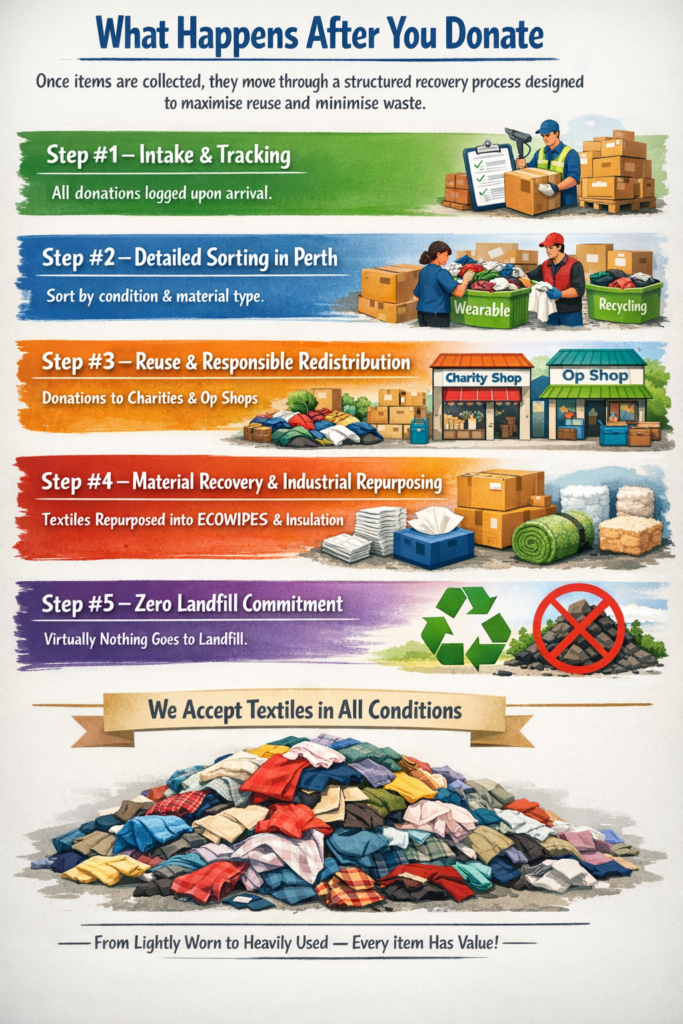
Once items are collected, they move through a structured recovery process designed to maximize reuse and minimize waste.
Step #1 — Intake & Tracking
All donations are logged upon arrival to maintain transparency and accountability.
Step #2 — Detailed Sorting in Perth
Items are assessed by condition and material type. Wearable clothing is separated from textiles suitable for recycling or industrial use.
Step #3 — Reuse & Responsible Redistribution
Usable garments are directed to local charities, op shops, community programs, or ethical resale channels. Where export is necessary, it follows documented Trade-Not-Aid principles to prevent dumping.
Step #4 — Material Recovery & Industrial Repurposing
Unwearable textiles are converted into industrial wipers (ECOWIPES), insulation fiber, stuffing materials, or other secondary products—reducing reliance on virgin resources.
Step #5 — Zero Landfill Commitment
Our processes are designed to ensure virtually nothing goes to landfill, with recovery and recycling prioritized at every stage.
We accept textiles in all conditions—from lightly worn clothing to heavily used fabrics—because value can still be recovered through reuse or material processing.
What Happens to Clothes That Can’t Be Reused
Not every garment can be worn again, but that does not mean it becomes waste.
Textiles that are torn, stained, or otherwise unfit for resale are directed into specialized recovery streams. Through mechanical processing, fiber separation, and industrial repurposing, materials are converted into new, usable products rather than discarded.
This matters in Australia, where significant volumes of clothing still enter landfills each year. By recovering fiber and extending material life cycles, textile recycling reduces emissions, conserves raw resources, and prevents long-term environmental damage.
Because even unwearable items can serve a second purpose, donating through a structured program ensures materials remain in circulation instead of contributing to landfill growth.
Let’s find out exactly where to drop off your bags across the city—and which suburbs we serve.
Where To Find Clothing Donation Bins in Perth
We have secure clothes donation bins across Perth suburbs, plus free pickup options and parcel post for regional donors. Use the locator to find the nearest drop box or book a Click & Collect if you prefer a doorstep pickup.
Where we regularly place drop boxes:
We locate donation bins in community hubs across Perth and surrounding areas, including suburbs such as Joondalup, Osborne Park, Fremantle, Canning Vale, Midland, Rockingham, and Bayswater (and many more). This spread helps make donating easy whether you live in the north, south, inner city, or outer suburbs.
What our bins accept:
- Clothes (good or worn)
- Shoes (paired or in sealed bag)
- Bedding (sheets, doonas, blankets)
- Bags (handbags, backpacks)
- Small-medium soft toys (teddies)
Tired of overflowing wardrobes but worried your unwanted clothes will end up in landfill or dumped overseas?
Declutter Responsibly with Clothing Please & Help Someone in Need
At Clothing Please, our motto is simple: “Your old is someone’s new.”
With over 45 years of textile recycling experience, we make it simple to clear space, help someone needy, and keep textiles out of landfill. Choose a local drop box, book a free Click-Collect in the Perth metro area, or order a prepaid parcel post bag if you live outside Perth.
Everything you donate is tracked, sorted in Perth, and either reused, upcycled into industrial wipers (ECOWIPES), or responsibly recycled; never left to pollute our beaches or landfills.
Donate Clothes Now
FAQs
Can I donate damaged or stained clothes?
Yes. Damaged, stained, or worn textiles still have value. They can be upcycled, shredded into industrial wipers (ECOWIPES), or processed into fiber for insulation and industrial use. Donating them keeps materials in circulation instead of in a landfill.
Are clothes donation bins safe to use?
Yes. Our bins are secure and clearly labeled. For added safety, use sealed bags and avoid leaving items unattended beside the bin. For large donations, book Click-Collect or a bulk pickup to ensure secure handling.
What happens to my donated clothes?
Donations are logged, sorted in our Perth warehouse, and graded. Wearable items go to community partners or resale. Unwearable clothes are recycled, upcycled, or converted into industrial products—with an aim of near-zero landfill.
Do donation bins send clothes overseas?
Some consignments may be ethically exported for specialist recycling or processing, but under strict, tracked programs (Trade-Not-Aid) that create jobs and prevent dumping. Local priority goes to WA communities.
Are clothes donation bins free to use?
Yes. Drop box donations and standard Click-Collect for the Perth Metro is free under our normal terms. Parcel Post bags for regional donors use a prepaid label we supply. Check the locator page for current terms and any T&Cs.