

Got torn T-shirts, greasy old rags, or stained towels piling up? Wondering what to do with damaged clothes that can’t be donated?
Tossing them in the bin feels wrong and it is. Every year, tonnes of textiles end up in landfills simply because people don’t know where to take them.
If you’ve ever Googled “rag bins near me” or “textile recycling in Perth,” you’re in the right place.
This guide will explain everything including what rag bins are, how they overcome Perth’s textile waste problem, what you can drop off, and how the recycling process works. We’ll also list some tips for safely disposing of greasy or hazardous rags.
Let’s make clearing out your wardrobe simple, sustainable, and zero-waste.
What Are Rag Bins?
Rag bins are special donation containers for worn-out or unwearable textiles. They’re also called clothing recycling bins or textile drop boxes). You’ll often find them in supermarket car parks, near charity stores or community centers.
Unlike regular clothing donation bins which only accept good-quality clothes, rag bins are meant for the unwearable stuff like the holey socks, ripped sheets, stained rags and torn jeans. Basically, if you wouldn’t gift it to a friend, a rag bin is the place to try.
Rag bins may be labeled “Rag House” or “Clothing Deposit Bin,” but whatever they’re called, their goal is the same: keep your ragged clothing out of the bin and into a better use.
How Rag Bins Help Solve Textile Waste Problem in Perth
Perth generates huge amounts of textile waste each year. In fact, nationwide over 300,000 tonnes of clothing and fabrics are sent to landfill or exported annually.
A growing share of this comes from WA, fueled by fast fashion and a big population. When textiles hit the landfill, they don’t just disappear, they degrade slowly and cause havoc.
Natural fibers eventually break down, but synthetic fabrics, like polyester and nylon, can take centuries to decompose. As they rot, unwanted clothes emit methane and toxic chemicals into the environment. Methane is a powerful greenhouse gas (over 25× stronger than CO₂), and finishes leaching into soil and waterways cause pollution.
The result: climate impacts, microplastics in the environment, and wasted resources.
Rag bins help reverse this trend by diverting textiles from landfill.
Instead of throwing old clothes in the trash, you drop them in a bin where they get collected and recycled locally.
This has big environmental and community benefits:
- Landfill reduction: Every rag bin drop keeps fabrics out of the rubbish. Less textile waste means fewer greenhouse gases and toxins from decomposition.
- Resource conservation: Reusing and recycling fibers saves water, energy and materials that would go into making new textiles.
- Circular economy: Collected textiles feed local recycling markets. Much of the material is turned into products like industrial wiping cloths or insulation instead of producing virgin material.
- Community support: Many rag bins are run by charities or partners like Clothing Please. Funds and materials from donated fabrics support local social programs and create jobs in sorting and processing.
In essence, rag bins make every piece of fabric count. Each item dropped off is kept in use, reducing emissions and helping people.
How Rag Bins & Textile Recycling Work
Rag bins are just the first step in a larger recycling chain. Here’s how your old clothes go from drop-off to new product:
Step #1: Collection
You fill a rag bin or textile drop box with bags or loose clothes. Some services also offer mail-back or pickup options. For example, at Clothing Please, we can send you a free recycling bag to post, or pick up bulk loads from businesses.
Step #2: Sorting & Grading
At the recycling facility, all donations are sorted. Workers separate wearable clothes from rags. Good-quality items may go to charity resale shops or overseas markets. Torn, stained or unmatched pieces become rag material. They’re further sorted by fabric type (cotton, wool, synthetic, etc.) because each is recycled differently.
Step #3: Processing
Now the magic happens.
- Wearable garments get cleaned and sent on to charity shops or people in need.
- Leftover rags enter manufacturing streams. Cotton and natural fibers get cut and repurposed into wiping rags for workshops, garages, cleaning cloths.
- Synthetic fabrics can be shredded and turned into insulation batting, stuffing for furniture, or re-spun into new yarn.
Some recycling outfits even use advanced methods like chemical recycling to recover polyester fibers. For example, ECOWIPES use recycled cotton sheets to make high-quality industrial wipe cloths.
Read more details > What happens to the donated clothes in charity bins?
Textile Recycling Methods: Downcycling vs. Upcycling
Downcycling means making a lower-grade product e.g. shredding old towels into cleaning rags. Whereas, upcycling means creating a product of equal or higher value like remaking denim jeans into bags.
Rag bins mostly achieve downcycling, but even that is valuable. It keeps materials in use.
Almost all items collected are either reused or recycled, keeping textiles out of the landfill. Roughly 80% of donated clothing is reused as clothing or upcycled, and only about 5% ends up downcycled into industrial rags or stuffing.
The goal is to approach 100% reuse of fabrics.
And Clothing Please guarantees zero landfill, anything dropped off is reused or processed into something new, not trash.
What You Can and Can’t Drop in a Rag Bin
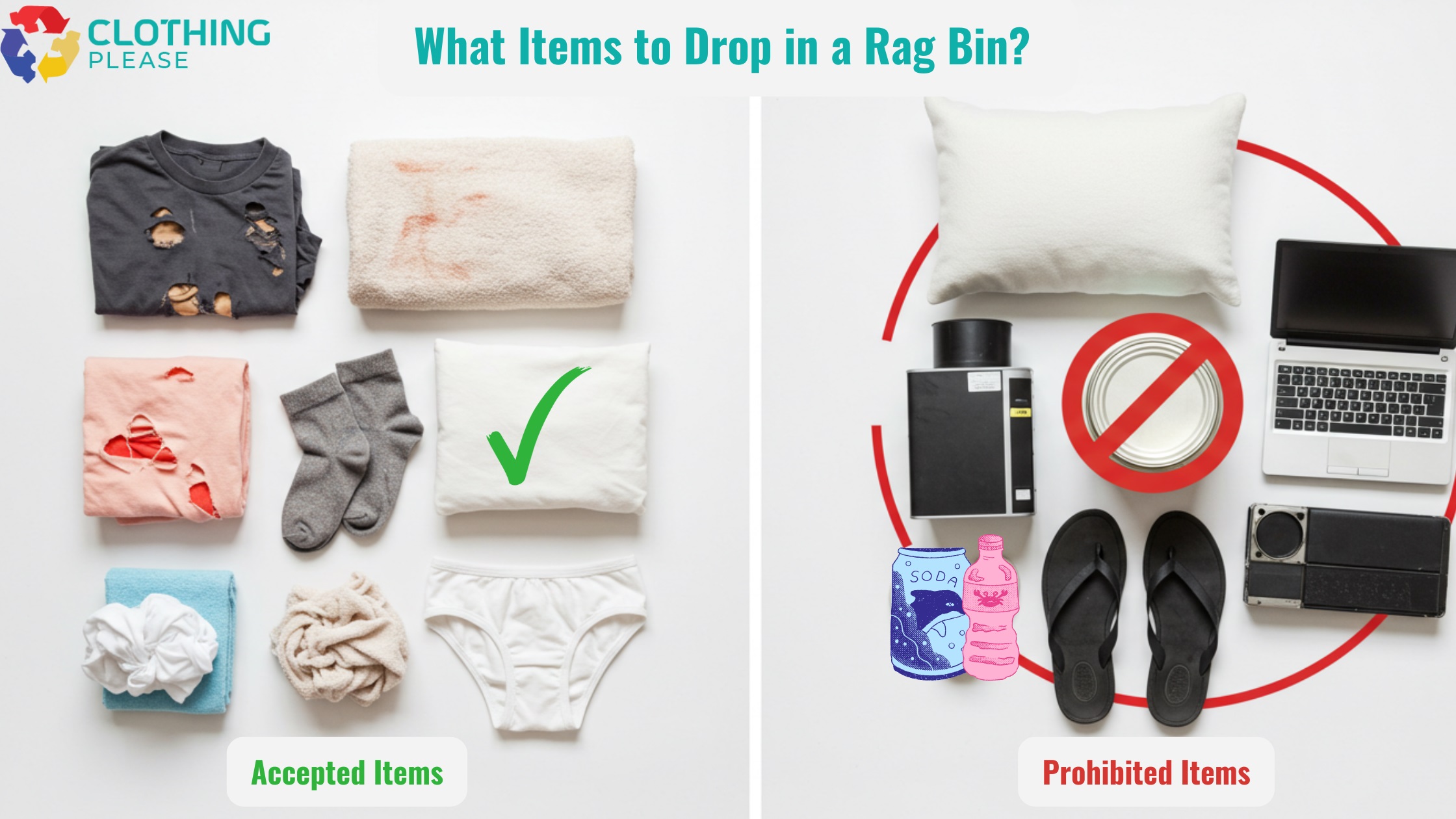
Items to Drop in a Rag Bin:
Rag bins will take almost any fabric item in any condition. Typical accepted materials include:
- Worn-out clothing: Torn or stained T-shirts, shirts, pants, underwear, socks, bras, etc. (Yes – even underwear and socks with holes are accepted)
- Household linens: Old towels, bed sheets, pillowcases, blankets, curtains, tablecloths, and other fabric homewares.
- Mixed fabrics: Cotton, wool, polyester blends, denim, linen – both natural and synthetic materials.
- Odd scraps: Mismatched gloves, single socks, fabric scraps or rags used for cleaning.
Prohibited Items:
To keep the recycling stream clean and safe, certain things should not go into rag bins. Avoid dropping off:
- Non-textiles: Glass, metal, electronics, plastics, foam padding, or rubber. These belong in your regular waste or other specialised bins.
- Bulky or heavy items: Large carpet rolls, furniture, mattresses, or big cushions. These need special bulky waste pickup.
- Hazardous materials: Paint cans, chemical-soaked rags, acids, or battery waste. Especially oil- or solvent-soaked rags. These must go in a designated oily rag bin.
- Biohazardous/soiled items: If fabric is heavily soiled with mould, bodily fluids or animal waste, check with your local council. Some rag bins may accept lightly soiled items like slightly dirty work clothes. But deeply contaminated ones usually require special disposal.
Read more about > 10 Outfits to Drop in Clothes Recycling Bins
Safe Disposal for Oily & Hazardous Rags
Not all rags are the same. Oily or solvent-soaked cloths like paint rags, oily workshop towels, need special handling due to fire risk. Here’s how to dispose of these safely:
- Use designated oily-rag bins: Look for metal oily rag bins (often red or yellow) at workshops or recycling centres. These are built to safely store flammable cloths. Never throw oily rags in general trash or charity drop boxes.
- Do not ball them up: Crumpled oily rags can spontaneously catch fire as heat builds inside. Always lay them flat or place loosely in the bin to let heat escape.
- Store them properly: No bin nearby? Use a metal container with a tight lid (like an old paint tin). You can also submerge the rags in water with detergent to cut off oxygen.
- Empty bins regularly: Even proper containers can get dangerous. Empty oily rag bins daily, if possible, especially in workshops or garages.
- Know the Rules: Some recycling programs won’t accept heavily soiled or chemical-soaked rags. Check bin instructions or take them to your local hazardous waste facility.
Tired of finding rag bins in Perth?
Recycle Rags with Clothing Please – Perth’s Best Drop-Off Solution
If you’ve got piles of old clothes or oily rags that need recycling, we’ve got you covered. Clothing Please offers easy options beyond bins:
- Parcel Post & Pickup: We’ll send you a free recycling bag. Fill it with clothes or rags and post it back, or book a click-&-collect pickup for bulk loads. No driving required.
- Click & Collect Drop-off: Prefer to hand it in? Drop your filled bag at one of our partner store locations across Perth.
- 100% Recycled, Zero Landfill Guarantee: Every item we accept is reused or recycled in Australia. We promise 100% recycling. No textile ends up as garbage.
So, bring your unwanted clothes to us and help Perth hit that zero-landfill goal.
Locate a Rag Bin – Use our interactive Perth map to find all clothing/textile drop boxes.
FAQs About Rag Bins
What materials do rag bins accept?
Any clothing or textile fabric in any condition. Torn or stained shirts, socks, towels, sheets, even underwear, rag bins take it all. Basically, if it’s cloth, you can usually drop it off.
Can I drop off wet or greasy rags?
Wet (water-soaked) fabrics are fine once drained, but greasy/oil-soaked rags require an oily rag bin or must be dried first. Safety rules say oily rags go in dedicated bins to avoid fire.
Are rag bins free to use?
Yes. Most rag drop boxes in Perth are run by charities or councils and are free for public use. You shouldn’t be charged to recycle textiles.
Where can I put old clothes that can’t be donated?
Put old clothes in rag bins or donate to textile recycling centers. If clothes are too ripped or stained for charity, a rag bin is ideal. We also offer mail-back bags or pickups for any old fabric. Just locate a Clothing Please bin or order a free bag.
What to do with ripped or stained clothes?
Put them in a rag bin or recycling program. That’s exactly what they’re for. These items will be shredded into industrial rags or fiberfill instead of going to waste.
Are there rag recycling bins near me?
Yes! Many suburbs have rag bins. To find the closest one, use our interactive map/locator, search online for “textile recycling Perth,” or check with your local council’s waste page.
Do you accept rags?
Absolutely. We accept all rags; torn, stained or clean, as long as they’re dry textiles. Any unwanted clothing can be brought to our bins or sent in our prepaid bag.
Can I drop off stained rags?
Yes! Rag bins and recycling services like Clothing Please are designed for stained or soiled fabrics. Feel free to drop them in as-is. Just make sure they’re not dripping liquids.