
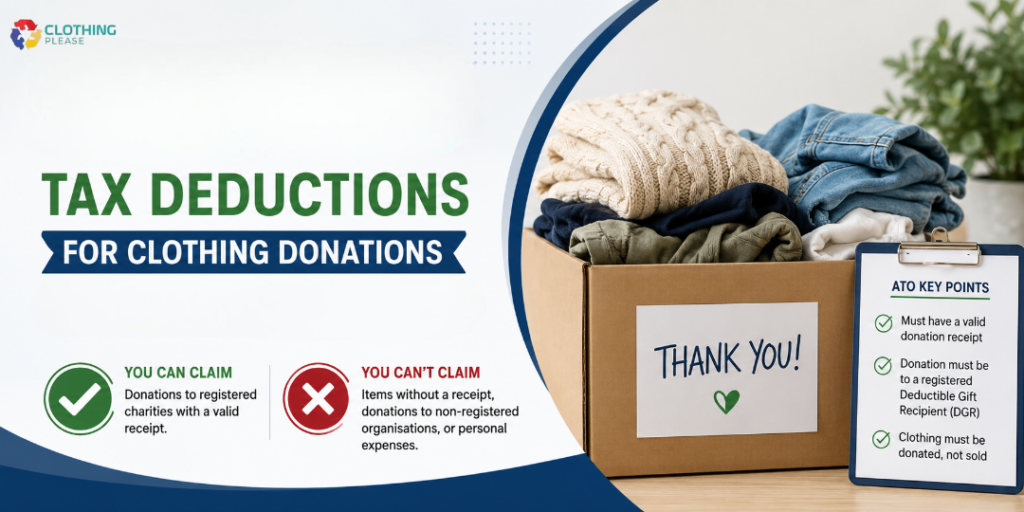
Australians donate millions of dollars’ worth of clothing every year. It’s a generous habit, and sometimes a smart tax move.
ATO only provides tax deductions on donating new clothes to charity organisations that have a Deductible Gift Receipt (DGR) status and are endorsed by the ATO. While old clothes, whether they qualify for the tax deduction or not, depend on the conditions.
Besides that, keep in mind that not every clothing donation earns you a deduction. The ATO has specific rules, and getting them wrong can cost you at tax time.
This guide breaks down exactly what qualifies, what doesn’t, and how to make sure your donations to charity efforts in Australia work in your favour at tax time.
What Things Make a Clothing Donation Tax-Deductible in Australia?
Your donation must go to an eligible Deductible Gift Recipient (DGR), be made voluntarily, and receive no material benefit in return.
ATO Rules for Claiming Tax-Deductible Donations
The ATO requires all four of the following for a clothing donation to qualify:
- The donation is made voluntarily, purely with no obligation attached
- You receive no material benefit in return (goods, services, or significant advantage)
- The organisation has DGR (Deductible Gift Recipient) status
- The donation meets ATO gift conditions for that specific DGR
If you miss any of the conditions, your claim will be rejected.
Let’s understand from an example.
“Sarah bags up several items of quality clothing and drops them at a registered charity with DGR status. She gets a receipt. The donation was voluntary, she received nothing in return, and the organisation is an approved DGR. Sarah can claim the deduction.”
Now, suppose Sarah drops the same clothes into a bin at a clothes donation point run by a for-profit resale business or an unregistered group; the donation generally won’t qualify for a tax deduction.
How to Check Whether an Organisation Is a Deductible Gift Recipient (DGR)
A DGR is an organisation or fund endorsed by the ATO, or listed by name in tax law, to receive tax-deductible gifts. Not every registered charity is a DGR; these are two separate things.
You can verify DGR status instantly using the ABN Lookup; search by name or ABN before you donate.
Common Misconceptions
- Being a registered charity does NOT automatically mean DGR status
- Crowdfunding campaigns, even for genuine causes, are usually not run by DGRs
- Community fundraisers or social media appeals rarely qualify
Always check first. A two-minute search can confirm whether your charity donation in Australia will count at tax time.
Non-Profit vs For-Profit Organisations: Which Donations Are Tax-Deductible?
First, keep in mind,
“Non-profit does not equal tax-deductible.”
Only donations to DGR-approved organisations can qualify for tax deductions. Many non-profits don’t have DGR status. And for-profit organisations, no matter how community-minded they seem, generally cannot receive tax-deductible gifts.
Some Common Examples Are
Can Claim | Cannot Claim |
Registered charity with DGR status | For-profit, op-shop, or resale store |
Approved community welfare organisation | Non-DGR & non-profit |
National DGR-endorsed clothing drives | Local fundraising groups without DGR |
Precisely, when you donate clothing through a DGR-approved bin collection service, you may be eligible. When you drop items at a commercial resale shop, you’re not.
What Gifts and Donations You Can and Can’t Claim on Tax
Understanding this difference is one of the tax benefits of donating that many Australians skip.
Donations You Can Generally Claim
- Money or goods donated to eligible DGR charities
- Clothing donations meeting ATO property gift rules
- Donations where no benefit is received in return
- Monetary gifts of $2 or more to DGRs
Donations You Generally Can’t Claim
- Raffle or lottery ticket purchases, even for charity
- Auction items bought at charity events
- Membership fees to clubs or associations
- Any donation where you receive goods, services, or personal advantage
- Gifts to crowdfunding campaigns without DGR status
Except that token promotional items (like a wristband or sticker) given by a DGR don’t disqualify your claim. Because they have no real material value.
Why Keeping Proper Donation Records Is Important for Tax Claims
Keeping donation records matters because, without a receipt, you can’t claim.
The ATO requires written evidence for most donation claims. A valid receipt should include
- The organisation’s name and ABN
- The date of the donation
- The amount donated or the description of items donated
- A statement that the gift is tax-deductible (for property donations)
For cash bucket donations to DGRs, you can claim up to $10 without a receipt. Anything above that requires documentation.
Besides that, the ATO recommends that you keep these records for five years from the date you lodge the return in which you claim the deduction.
If you’re making higher-value clothing donations, it’s worth getting a written valuation from a qualified independent valuer. The ATO may require this for non-cash property gifts above a certain range.
How to Claim Clothing Donation Tax Deductions: Step-By-Step Process
Here is a step-by-step process to claim a tax deduction when donating clothes.
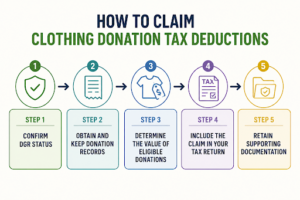
1: Confirm DGR Status
Check the organisation’s DGR status at ABN Lookup before donating. This takes only under two minutes.
2: Obtain and Keep Donation Records
Ask for a receipt at the time of donation from an organisation. If you’re using a bin clothes donation service in Australia, check whether the organisation issues receipts and whether they hold DGR status.
3: Determine the Value of Eligible Donations
For clothing donations (non-cash property), the value is generally the market value at the time of the gift. If items are worth more than $5,000, the ATO requires a valuation from a qualified independent expert.
4: Include the Claim in Your Tax Return
Report the total deductible donations in the gifts or donations section of your tax return. Keep the receipts on file; don’t submit them, but have them ready if the ATO asks.
5: Retain Supporting Documentation
Hold onto receipts, valuations, and any written correspondence for at least five years. Moreover, digital copies are accepted.
Expert Tips To Prepare for Donation Claims Early
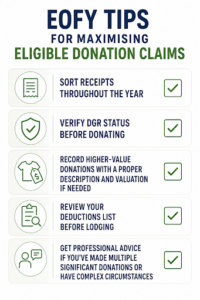
The end of the financial year (30 June) is the deadline for donations you want to claim as a donation on your tax return for that income year. Here’s how you can get organised
- Sort receipts throughout the year, not just in June; it saves significant stress
- Verify DGR status before donating, especially for new or unfamiliar organisations
- Record higher-value donations with a proper description and valuation if needed
- Review your deductions list before lodging, as missing one receipt can cost you
- Get professional advice if you’ve made multiple significant donations or have complex circumstances.
Create a folder, either physical or digital, specifically for donation receipts. Add to it as you go. By June, the major work is already done.
Start Donating Smart, and Make It Count
Understanding ATO rules is important to make your donations beneficial for you. Here’s what you can do: donate to a DGR-registered organisation, keep your receipt, and make sure no material benefit was received, and you’re well on your way to a legitimate claim.
Not all clothing donations lead to a tax deduction, but donating to the right organisation can.
And are you looking for a trusted organisation that works for environmental conservation to give charity to in Australia? Donate your clothes to Clothing Please!
We are an eco-friendly clothing donation service in Perth, Western Australia, with over 45 years of dedication to keeping clothing out of landfill.
- We operate bin clothes donation drop-off points across WA.
- You can donate clothing, shoes, and bags to us in any condition.
- We recycled every item responsibly.
If you want to know whether Clothing Please is DGR registered, contact us or call 08 9302 3456!
FAQs
Can I get a tax write-off for donating clothes?
Yes, but only if the clothing is donated to a DGR-approved organisation, you receive no material benefit in return, and you hold a valid receipt. Donations to for-profit stores or non-DGR groups don’t qualify for tax deductions.
Are donations 100% tax-deductible in Australia?
Generally, yes, eligible donations to DGRs can be claimed in full. For clothing (non-cash property), the deductible amount is typically the market value of the items at the time of donation, subject to ATO valuation rules.
What’s the maximum tax write-off for donations?
There’s no upper cap on deductible donations to most DGRs. However, the deduction cannot create or increase a tax loss; any excess can be spread over up to five income years in some circumstances.
Is it worth claiming charitable donations?
Yes, but if you meet the ATO requirements. Even modest donations reduce your taxable income. The real benefit grows if you’re a regular donor across the financial year. Always keep receipts and confirm DGR status.